
Singh said the nation and the society as a whole are gradually getting conditioned to look at things in the eye instead of getting confused by duplicities.

Before taking such loans, compare the interest rates charged by various players, advises Sanjay Kumar Singh.

'Nehru wanted to strengthen industries by exploiting agriculture and that policy was continued by successive governments.'

16 national and regional industry bodies and sectoral business lobbies video-conferenced with Commerce and Industry Minister Piyush Goyal on Saturday and raised key concerns facing Indian industry in the wake of the 21-day lockdown over coronavirus.

The new law will have penal provisions of Rs 50 lakh and five year imprisonment for celebrities promoting sale of items without verifying the quality.
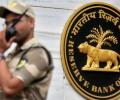
The Reserve Bank of India on Wednesday retained the economic growth projection for the current financial year at 10.5 per cent, while cautioning that the recent surge in COVID-19 infections has created uncertainty over the economic growth recovery. In its last policy review, the RBI had projected a GDP growth rate of 10.5 pc for FY'22. Taking various factors into consideration, it said, "the projection of real GDP growth for 2021-22 is retained at 10.5 per cent consisting of 26.2 per cent in Q1, 8.3 per cent in Q2, 5.4 per cent in Q3 and 6.2 per cent in Q4."

Bharti Global is planning to put up more satellites and has set a stiff deadline to launch commercial Internet services by October in the UK, Alaska, northern Russia and northern Europe.

To make possible discretionary spending including capex and that on welfare, the government decided to borrow more than planned in FY21 -- Rs 12.7 trillion.

'Pump prices of petrol and diesel have reached historical highs. An unwinding of taxes on petroleum products by both the Centre and the states could ease the cost-push pressures,' the Monetary Policy Committee (MPC) has said.

The political script for pre-2019 politics has gone with the wind and the writers of the new script seem in no great hurry to oblige the tormented, observes Mohammad Sayeed Malik, the distinguished commentator on Kashmir affairs.

'As valuations of large-caps appeared to be out of whack, investors started lapping up quality mid-caps and small-caps, which were available at relatively comfortable valuations.'

Mutual funds (MFs) are set to be net sellers of Indian equities for the first time in the past seven financial years, having sold stocks worth about Rs 1.27 trillion so far in 2020-21 (FY21), making it the highest net sales on record in a financial year. MFs had been net buyers in the previous six financial years, including purchases of over Rs 1.41 trillion in FY18, Rs 88,152 crore in FY19, and Rs 91,814 crore in FY20. The last time they offloaded Indian equities was in FY14, when they net sold stocks worth Rs 21,159 crore. In contrast, foreign portfolio investors (FPIs) have ramped up buying in FY21, purchasing more than Rs 2.6 trillion worth of shares.

Union Minister of Commerce and Textiles Piyush Goyal has stirred up a hornet's nest by taking on India Inc, specifically the Tata group, which is among the companies that lobbied against the Modi government's pro-consumer draft e-commerce policies. While Goyal's comments, made at a Confederation of Indian Industry (CII) event, were streamed live on YouTube, the industry lobbying body later edited the video and subsequently withdrew the entire speech. Goyal had said the Tata group and other Indian companies often lobbied for their interest, while ignoring national interest.
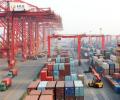
The study, 'Trade and trade diversion effects of United States tariffs on China', shows that the ongoing US-China trade war has resulted in a sharp decline in bilateral trade, higher prices for consumers and trade diversion effects -- increased imports from countries not directly involved in the trade war.

Ajit Balakrishnan on learning from past technology revolutions.

Modi made a strong case for a partnership between the producers and consumers in the oil market as it exists in other markets.

The Asean secretariat hopes the meet may be able to iron out existing wrinkles raised by India. Since there had been no significant progress on the matter over the past two years on most issues, New Delhi is yet to decide on the invite.

Opposition parties have alleged that the two agriculture Bills will undermine the safety net provided to the farmers by the MSP system and will lead to their exploitation by big companies.

With only a handful of models by a few manufacturers including Tata Nexon, MG ZS, Hyundai Kona, among others, the segment has remained under tapped.

The Seventh Pay Commission had decided to choose the CPI-IW as the index for adjusting inflation for central government employees.

'In the last 4, 5 years, ever since online companies started online shopping in a big way with heavy discounts, our sales are affected badly.' 'As there is no control over the way the online companies operate, they were able to destroy the domestic retail market to a great extent.'

With nearly 100 countries closing national borders during the past month, the movement of people and tourism flows have come to a screeching halt. The contraction could be even higher if governments fail to provide income support and help boost consumer spending.

Ajit Mishra, vice president, research, Religare Broking, answers your stockmarket queries.

The government hopes that the PLI schemes would provide 200,000-300,000 direct employment over five years, according to sources in the know.

Chinese companies have 'designed' the sugar syrup which is used to adulterate honey so that it can pass Indian laboratory tests, reveals Sunita Narain.

The government on Wednesday approved a production-linked incentive (PLI) scheme for the pharmaceutical sector, entailing an outlay of Rs 15,000 crore. The Union Cabinet, chaired by Prime Minister Narendra Modi, approved the scheme which will benefit domestic manufacturers, help create employment and is expected to contribute to the availability of a wider range of affordable medicines for consumers. The duration of the scheme would be from 2020-21 to 2028-29 and is expected to promote the production of high value products in the country and increase the value addition in exports, an official release said.

In this event, it is the IAF that showed true professionalism, telling the boss they weren't going to fly in that weather. You can see what professionalism and moral courage it takes to say no to your prime minister. Only things like that can keep him safe, observes Shekhar Gupta.

In yet another blow for Nestle India, live larvae and worms have been found in their milk powder in Coimbatore.

Ahead of a meeting of oil producers' cartel OPEC, India on Tuesday said the current oil prices are "very challenging" and rates need to be a "little bit sober" lest they impact a consumption-led recovery of the global economy. Oil Minister Dharmendra Pradhan, who last week again urged OPEC to phase out its production cuts, said India is a price-sensitive market and it will buy oil wherever it gets competitive rates. The rebound in international oil prices from lows hit last month on the back of demand recovery has led to a spike in petrol and diesel retail prices in India.

Industry clueless about implementing labelling ru#8804 FSSAI dithers over regulations.

Besides foreign flows, corporate earnings and US Federal Reserve chief Janet Yellen's testimony to the nation's legislature are also likely to impact investor sentiment.

"We now realise that the so-called farmer agitation hardly remains a farmers' agitation. It has almost got infiltrated by Leftist and Maoist elements, a flavour of which we saw over the last two days when there were extraneous demands to release people who have been put behind bars for anti-national (and) who have been put behind bars for illegal activities," Goyal, the Minister for Railways, Commerce and Industry and Food and Consumers Affairs, said at FICCI's annual meeting.

Consumers are paying an exorbitant 180 per cent tax on petrol, and 140 per cent on diesel in Delhi and in most other towns in India. Little wonder then that the central government expects a staggering Rs 3.46 trillion by levying excise duties on retail sale of the two fuels this year, and Rs 3.2 trillion the next. States would generally have had reason to cheer, as they command a 41 per cent share in Centre's tax revenues. But as the Centre has raised excise duties in the form of "cess," the revenue proceeds are by nature not shareable with states.

While the meetings on Friday were preliminary discussions, it is learnt that sectors like tourism; hospitality; aviation; micro, small and medium enterprises (MSMEs); and livestock have sought deferring loan repayments and temporary tax holidays in specific cases to help them tide over the steep fall in economic activity.
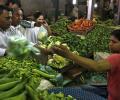
Declining vegetable prices brought down the retail inflation to a 15-month low of 4.59 per cent in December and within the comfort zone of the Reserve Bank, government data showed on Tuesday. It is for the first time during the current fiscal that the Consumer Price Index (CPI) based inflation print is below 6 per cent or in the RBI's target range of 2 to 6 per cent. The central bank factors in the CPI-based inflation while arriving at its monetary policy. The inflation in December 2020 came down from 6.93 per cent in November, mainly on account of 10.41 per cent decline in vegetable prices over the year-ago period.

Addressing a press conference, Pawar, a Rajya Sabha member, also bemoaned the conduct of Deputy Chairman Harivansh and the Modi government's decision of "bulldozing" the Opposition in the House.
India might not have started growing genetically modified food crops, but it does import food products that contain GM ingredients. Consumers who buy them have no way of knowing what they contain. The government has come up with guidelines to let you know if the item purchased is genetically modified.
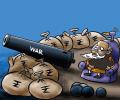
Inflation targeting has worked well and the government must stay with it, and the framework is going to work well in the period ahead also, former RBI Governor D Subbarao said on Thursday. He also said low inflation contributes to sustainable growth. Addressing the 'Times Network India Economic Conclave' virtually, Subbarao said the government's proposal to privatise some public sector units is not akin to selling family silver but it is a route for putting India on a sustainable growth path.

'Almost 70 per cent production time of a vaccine is dedicated to quality control, which is done through several hundred tests.'

The Tamil Nadu Assembly on Saturday adopted a resolution urging the Centre to withdraw three contentious farm laws, against which farmers have been holding protests outside Delhi for months.
 © 2026 Rediff.com - Advertise with us - Disclaimer - Privacy Policy - Sitemap - Feedback - About us - Terms of use - Grievances